

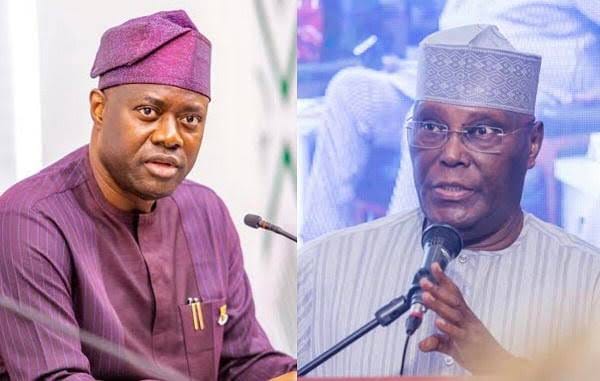
The opposition’s intensifying search for a united front ahead of the 2027 elections is generating a potentially explosive political question: could Rotimi Amaechi’s emerging vice-presidential position give way to an Atiku Abubakar-Seyi Makinde ticket?
Sources familiar with behind-the-scenes consultations told THISDAY that the renewed coalition drive, particularly efforts to rally opposition forces around the African Democratic Congress (ADC), has revived Makinde’s name in discussions over a possible running mate for Atiku.
The proposal is reportedly among several options being considered as opposition leaders search for a platform and ticket capable of taking on President Bola Tinubu and the All Progressives Congress (APC) in 2027.
Another bloc is said to be examining the Nigerian Democratic Congress (NDC) as a possible alternative platform, underscoring the continuing uncertainty over which political vehicle will ultimately host the opposition coalition.
The latest push for unity is rooted in a familiar problem. Opposition parties and politicians have repeatedly struggled to overcome competing ambitions, fragmented structures and disagreements over presidential leadership, weakening their collective challenge to the APC in previous elections.
Now, influential political figures and civil society actors are warning that another divided opposition campaign could again give the ruling party a significant electoral advantage.
Former President Olusegun Obasanjo is believed to be playing a role in encouraging consultations among opposition leaders. THISDAY gathered that another round of discussions facilitated around him could involve major opposition figures, including Atiku, Peter Obi and Rabiu Kwankwaso.
The initiative has also attracted the support of G100, a coalition of 100 concerned Nigerians that recently called on opposition leaders to put aside personal ambitions and work towards a common electoral strategy.
In its open letter, “The Doctrine of a Necessity for Democratic Opposition,” the group advocated a single presidential candidate, common programme, coordinated campaign strategy and shared political objective.
Its associated figures include Salihu Moh. Lukman, Nnena Ukeje, Simon Achuba, Anthony Kila, Ayokunle Fagbemi, Salihu Tanko Yakasai, Zainab Buba Galadima, Aliyu Audu and Aminu Datti Ahmed.
The group appealed to a broad range of opposition figures, including former Senate President David Mark, Atiku, Obi, Makinde, Governor Bala Mohammed, Seriake Dickson, Amaechi, Kwankwaso and Rauf Aregbesola.
While G100 insists that it is not backing a particular politician or party, sources said the broader unity campaign is increasingly intersecting with negotiations over the composition of a possible consensus ticket.
The Atiku-Makinde option is reportedly gaining attention partly because of Makinde’s political structure and the financial demands of a nationwide presidential campaign.
Sources said some actors believe Makinde’s position as a sitting governor could provide organisational and financial advantages to a presidential campaign seeking to compete across the country.
Makinde, sources added, had featured in earlier discussions over Atiku’s running mate before Amaechi emerged as a key figure in the calculations surrounding the ticket.
Amaechi’s emergence reportedly followed intense negotiations over the presidential nomination process, including threats of legal action arising from the outcome.
That history could make any attempt to displace him particularly contentious.
Party insiders said Amaechi, who fought hard to secure his place in the emerging arrangement, is unlikely to surrender the vice-presidential slot without a serious political contest.
This leaves opposition leaders facing a delicate calculation. They must broaden the coalition enough to give it a realistic chance against the APC while avoiding a fresh round of internal fractures among powerful politicians.
The central challenge is therefore no longer simply whether the opposition can unite. It is whether its leading figures can agree on who must lead that unity.
Should the Atiku-Makinde proposal gather momentum, the fate of Amaechi’s vice-presidential ambition could become one of the first major tests of the opposition’s ability to turn its 2027 unity campaign into a concrete political alliance.
