

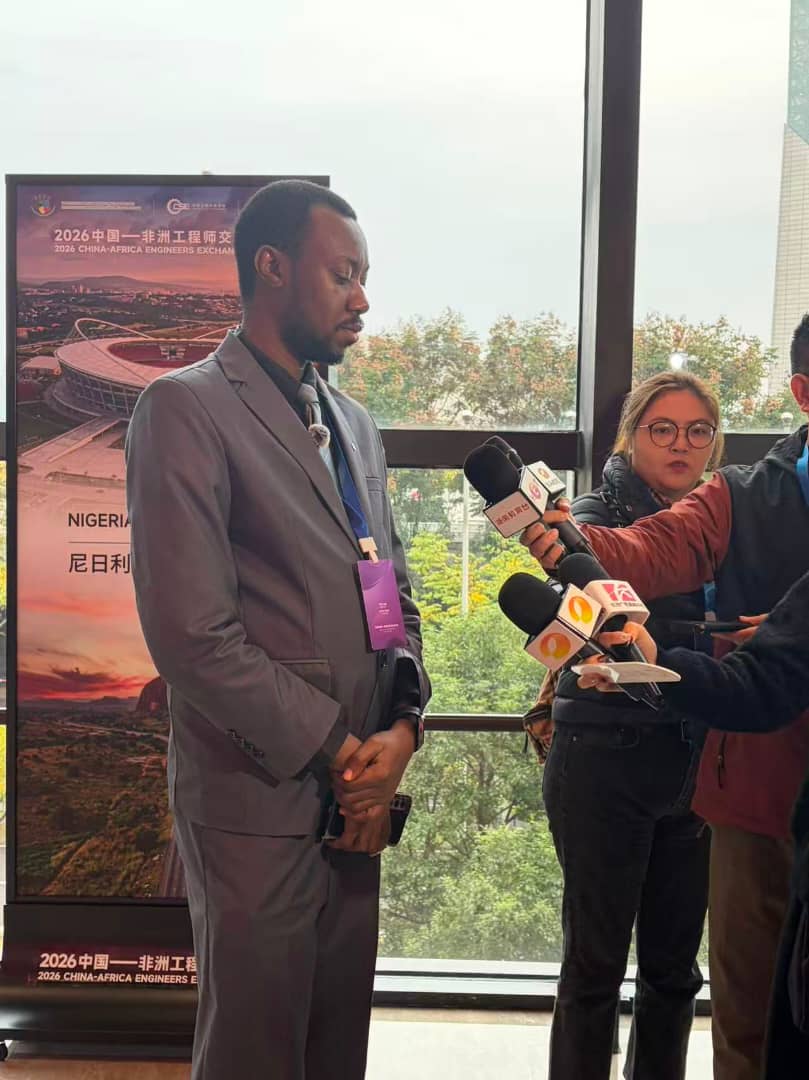
A Nigerian engineering leader, Engr. Olumayowa Ayodeji Idowu, FNSE, has advocated a new direction in Africa–China engineering relations, calling for partnerships that will strengthen Africa’s industrial base, promote homegrown technological solutions and equip African professionals with the expertise required for sustainable economic development. Idowu made the call during the inaugural 2026 China–Africa Engineers Exchange Programme, where he delivered a keynote presentation titled “Engineering Innovation for Sustainable Industrialization: Bridging China–Africa Technological Development” on Wednesday, November 18, 2026, at the Changsha North Star International Convention Center in Hunan Province, China.
The four-day international programme assembled 10 engineering professionals from eight African countries — Nigeria, Ghana, Zambia, Uganda, Rwanda, Kenya, Tanzania and Niger — under the auspices of the Federation of African Engineering Organisations (FAEO). The initiative was a follow-up to the Memorandum of Understanding signed in 2025 between FAEO, under the leadership of its President, Eng. Refilwe Buthelezi, Pr. Eng., and the China Association for Science and Technology (CAST).
The agreement established a framework for closer cooperation in engineering education, professional exchanges, technological research, industrial development and knowledge sharing. Idowu currently serves as Chairman of the Nigerian Society of Engineers (NSE) Branch Chairmen Forum and is a member of the World Federation of Engineering Organizations (WFEO) Hackathon Working Group and the FAEO Capacity Building Committee.
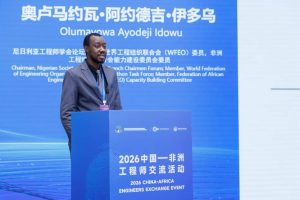
In his address, Idowu underscored the importance of repositioning African economies from dependence on imported technologies towards greater participation in technological design, production and innovation. He noted that China’s involvement in infrastructure development had contributed to improvements in transportation networks, electricity infrastructure, telecommunications and industrial facilities across Africa. Nevertheless, he argued that future cooperation should be structured to ensure that African engineers, researchers and manufacturers acquire the technical knowledge and industrial capabilities necessary to sustain these investments. He maintained that lasting industrial progress requires not only modern infrastructure but also a skilled workforce, competitive manufacturing industries and the capacity to develop indigenous technological solutions.
Speaking to journalists during the programme, Idowu outlined four priority areas for Africa’s engineering development: dependable energy infrastructure, efficient transportation and logistics systems, continuous professional and technical capacity building, and the enforcement of engineering standards and quality assurance. He called for practical partnerships that would expand research collaboration, facilitate industrial attachments, improve local manufacturing participation and provide young engineers with opportunities to work alongside experienced international professionals. According to him, African countries must pursue cooperation that builds long-term institutional and technological capacity. “The future of China–Africa engineering cooperation should not simply be about what China can build for Africa, but what China and Africa can jointly innovate, develop and sustain for future generations,” he said.
The exchange programme also created opportunities for dialogue among engineering practitioners, researchers, technology developers and institutional representatives from Africa and China. Through keynote presentations, technical sessions and technology exhibitions, participants examined emerging developments in sustainable industrial production, renewable energy systems, intelligent construction technologies, green mining and advanced engineering applications. The discussions highlighted the potential for joint innovation, technical knowledge exchange and stronger cooperation between professional engineering institutions and industrial stakeholders.
A major highlight of the engagement was the technical tour of selected Chinese engineering and manufacturing establishments, during which African delegates gained exposure to modern industrial facilities, intelligent production systems, automation technologies and innovative manufacturing processes. The visits offered practical perspectives on how engineering research, industrial investment and technological advancement can support manufacturing competitiveness. They also provided opportunities for professional interaction and discussions on adapting relevant technological solutions to Africa’s industrial and infrastructure development needs.
The programme attracted senior officials and representatives of engineering organisations, including Ing. Isaac Bedu, Registrar of the Engineering Council of Ghana and member of FAEO’s Registrars Committee, and Dr. Luo Hui, Executive Secretary for International Affairs of CAST and Vice Chairperson and Joint Secretary-General of the Chinese Society of Engineers. Held from November 17 to 20, 2026, the maiden China–Africa Engineers Exchange Programme reinforced the growing importance of international engineering cooperation in building technical expertise, advancing industrial innovation and creating sustainable economic opportunities, while providing a foundation for deeper institutional partnerships and mutually beneficial technological development between Africa and China.
